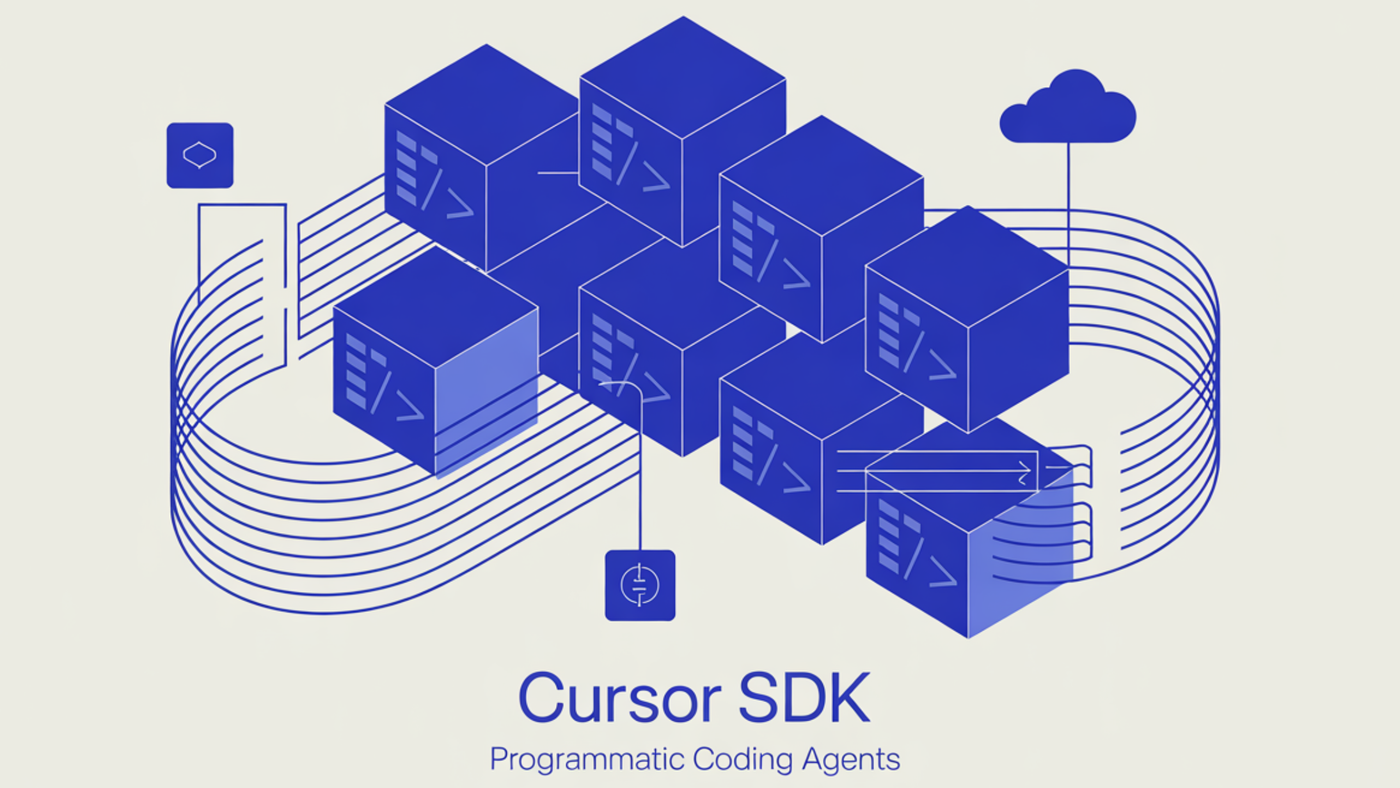
Cursor Launches TypeScript SDK to Let Developers Build and Deploy Programmatic Coding Agents The post Cursor Introduces a TypeScript SDK for Building Prog…
MarkTechPost lagi ngeluarin cerita yang cukup penting: Cursor Launches TypeScript SDK to Let Developers Build and Deploy Programmatic Coding Agents The post Cursor Introduces a TypeScript SDK for Building Programmatic Coding Agents With Sandboxed Cloud VMs, Subagents, Hooks, and Token-Based Pricing appeared first on MarkTechPost .. Buat AI, ini biasanya bukan cuma soal model atau demo baru, tapi soal arah product strategy. Kalau lo ngikutin ai updates, cerita kayak gini sering jadi tanda bahwa batas antara “eksperimen” dan “alat kerja harian” makin tipis.
Kalau kita lihat lebih jauh, Cursor, the AI-powered code editor, is opening up the core technology behind its coding agents to developers everywhere. The Cursor team announced the public beta of the Cursor SDK — a TypeScript library that gives engineers programmatic access to the same runtime, harness, and models that power Cursor’s desktop app, CLI, and web interface. This signals a meaningful shift in how AI coding tools are being positioned: not just as interactive assistants sitting alongside a developer, but as deployable infrastructure that organizations can wire into their existing systems. From Interactive Tool to Programmable Infrastructure If you’ve used Cursor before, you know it as an IDE where you interact with an agent in real time — asking it to write functions, fix bugs, or explain code. The Cursor SDK changes the access model. Instead of a developer sitting at a keyboard, the agent can now be invoked programmatically: from a CI/CD pipeline trigger, a backend service, or embedded directly inside another product. Think of it this way: previously, you had to be “in” Cursor to use its agents. Now, you can call those same agents from anywhere in your stack with a few lines of TypeScript. Getting started is a single command: Copy Code Copied Use a different Browser npm install @cursor/sdk From there, you create an Agent instance, send it a task, and stream the response back — all in TypeScript. Here’s the minimal example from Cursor’s announcement: Copy Code Copied Use a different Browser import { Agent } from "@cursor/sdk"; const agent = await Agent.create({ apiKey: process.env.CURSOR_API_KEY!, model: { id: "composer-2" }, local: { cwd: process.cwd() }, }); const run = await agent.send("Summarize what this repository does"); for await (const event of run.stream()) { console.log(event); } The Agent.create() call accepts an apiKey , a model field (where you specify which model to run), and either a local or cloud configuration depending on where you want execution to happen. Why Building Your Own Agent Stack is Hard Before diving into what the SDK offers, it’s worth understanding the problem it solves. Building fast, reliable, and capable coding agents that run safely against your data requires meaningful engineering effort: secure sandboxing, durable state and session management, environment setup, and context management. And when a new model ships, dev teams often have to rework their agent loops entirely just to take advantage of it. The Cursor SDK eliminates this complexity so teams can focus on building useful agents instead of maintaining the underlying infrastructure. https://cursor.com/blog/typescript-sdk The Agent Harness: What “Same Runtime” Actually Means SDK agents use the same harness that powers Cursor’s own products. ‘Harness’ here refers to the full set of supporting infrastructure that makes an agent effective beyond just the LLM call itself. In Cursor’s case, that includes: Intelligent context management — Codebase indexing, semantic search, and instant grep so agents retrieve the right code context before generating responses. This is critical because LLMs are only as good as the context they receive; poor retrieval leads to hallucinated or irrelevant outputs. MCP servers — Agents launched through the SDK can connect to external tools and data sources over stdio or HTTP, either via a .cursor/mcp.json config file or passed inline in the API call. MCP (Model Context Protocol) is an open standard for wiring tools into agent runtimes. Skills — Agents automatically pick up reusable behavior definitions from a .cursor/skills/ directory in the repository. Hooks — A .cursor/hooks.json file lets you observe, control, and extend the agent loop across cloud, self-hosted, and local runtimes — useful for logging, guardrails, or custom orchestration. Subagents — The main agent can delegate subtasks to named subagents with their own prompts and models via the Agent tool, enabling multi-agent workflows without custom orchestration code. Cloud Deployment: Persistent, Sandboxed, and Resumable One of the more practical features of the SDK is cloud execution. When configured to run in Cursor’s cloud, each agent gets its own dedicated VM with strong sandboxing, a clone of the target repository, and a fully configured development environment. Critically, the agent keeps running even if the initiating machine goes offline — the developer can reconnect and stream the conversation later. Cloud agents integrate with Cursor’s existing Agents Window and web app, so a task started programmatically via the SDK can be inspected or taken over manually inside the Cursor interface. When the agent finishes, it can open a PR, push a branch, or attach demos and screenshots — making them suitable for asynchronous, unattended workflows: Copy Code Copied Use a different Browser const agent = await Agent.create({ apiKey: process.env.CURSOR_API_KEY!, model: { id: "gpt-5.5" }, cloud: { repos: [{ url: "https://github.com/cursor/cookbook", startingRef: "main" }], autoCreatePR: true, }, }); const run = await agent.send("Fix the auth token expiry bug"); console.log(`Started ${run.id}`); // ...check back in later, from anywhere: const result = await ( await Agent.getRun(run.id, { runtime: "cloud", agentId: run.agentId }) ).wait(); console.log(result.git?.branches[0]?.prUrl); For dev teams with security requirements, the SDK also supports self-hosted workers, where both code and tool execution remain inside the organization’s own network. Model Flexibility and Composer 2 The SDK exposes every model supported in Cursor. Switching models is a single field change in the model parameter, letting teams route tasks to the best model for a given combination of cost and capability. Cursor’s own Composer 2 — described as a specialized coding model achieving frontier-level performance at a fraction of the cost of general-purpose models — is positioned as the default recommendation for most coding agent tasks. Getting Started To accelerate adoption, Cursor has published a public cookbook repository on GitHub with four starter projects: a minimal quickstart (a Node.js example that creates a local agent, sends one prompt, and streams the response), a web-based prototyping tool for scaffolding new projects in a sandboxed cloud environment, an agent-powered kanban board that automatically opens PRs when engineers drag a card, and a lightweight coding agent CLI for spawning Cursor agents from the terminal. Cursor has also released a Cursor SDK plugin in the Cursor Marketplace to help developers start building directly from within the editor. Key Takeaways Cursor SDK is now in public beta — Cursor has released a TypeScript SDK ( npm install @cursor/sdk ) that gives developers programmatic access to the same runtime, harness, and models that power the Cursor desktop app, CLI, and web interface. Eliminates the hard parts of building coding agents — Teams no longer need to engineer secure sandboxing, durable state and session management, environment setup, and context management from scratch — and won’t need to rework agent loops every time a new model ships. Runs locally or on Cursor’s cloud — Agents can execute on a developer’s local machine for fast iteration, on Cursor’s cloud against a dedicated VM with strong sandboxing, or on self-hosted workers for teams with strict network security requirements. Full harness included out of the box — SDK agents inherit Cursor’s complete infrastructure: intelligent context management (codebase indexing, semantic search, instant grep), MCP server support, Skills, Hooks, and Subagents — the same stack powering Cursor’s own products. Check out the Cookbook and Technical details . Also, feel free to follow us on Twitter and don’t forget to join our 130k+ ML SubReddit and Subscribe to our Newsletter . Wait! are you on telegram? now you can join us on telegram as well. Need to partner with us for promoting your GitHub Repo OR Hugging Face Page OR Product Release OR Webinar etc.? Connect with us The post Cursor Introduces a TypeScript SDK for Building Programmatic Coding Agents With Sandboxed Cloud VMs, Subagents, Hooks, and Token-Based Pricing appeared first on MarkTechPost . ngasih petunjuk tentang apa yang lagi dicari pasar: speed, reliability, dan output yang bisa diukur. Di AI, yang menang bukan yang paling heboh ngomongin capability, tapi yang paling gampang dipakai tim buat nyelesaiin kerjaan nyata.
Research tambahan ngasih konteks yang lebih tajam: Research lookup returned no usable results.. Ini bikin pembacaan awal jadi lebih grounded, bukan cuma bergantung ke judul atau ringkasan feed. Kalau ada detail yang saling nambah, gue pakai itu buat bikin cerita ini lebih utuh dan lebih berguna buat lo.
Di level produk dan operasional, cerita kayak gini biasanya nunjukin satu hal: perusahaan yang lebih cepat belajar bakal punya advantage. Kalau workflow makin otomatis, tim yang masih manual kebanyakan bakal kalah gesit. Kalau distribusi makin ketat, brand yang punya channel kuat bakal lebih unggul. Jadi meskipun judulnya kelihatan khusus, implikasinya sering masuk ke area yang jauh lebih dekat ke keputusan bisnis sehari-hari daripada yang orang kira.
Ada juga layer kompetisi yang sering kelewat. Begitu satu pemain besar bergerak, pemain kecil biasanya punya dua pilihan: ikut naik level atau makin susah relevan. Itu sebabnya gue suka lihat berita bukan sebagai peristiwa tunggal, tapi sebagai bagian dari pola. Siapa yang bergerak duluan? Siapa yang nunggu? Siapa yang bisa mengeksekusi lebih rapi? Dari situ biasanya kebaca apakah sebuah tren masih hype atau udah mulai jadi infrastruktur.
Buat pembaca yang peduli ke hasil praktis, pertanyaan yang paling berguna bukan “apakah ini keren?” tapi “apa yang harus gue ubah setelah baca ini?”. Kalau lo founder, bisa jadi jawabannya ada di positioning, pricing, atau channel distribusi. Kalau lo trader, mungkin yang perlu dipantau adalah sentimen, momentum, dan apakah pasar udah overreact. Kalau lo cuma pengin update cepat, minimal lo jadi ngerti kenapa topik ini muncul dan kenapa orang lain mulai ngomongin sekarang.
Gue juga sengaja ngasih ruang buat konteks yang sedikit lebih tenang, karena berita yang rame sering bikin orang lompat ke kesimpulan terlalu cepat. Tidak semua headline berarti revolusi. Kadang ada yang cuma noise, kadang ada yang benar-benar awal perubahan. Bedanya ada di konsistensi tindak lanjutnya. Kalau dalam beberapa siklus berikutnya topik ini terus muncul, besar kemungkinan kita lagi lihat pergeseran yang serius, bukan sekadar buzz harian.
Jadi kalau lo minta versi pendeknya: Cursor Introduces a TypeScript SDK for Building Programmatic Coding Agents With Sandboxed Cloud VMs, Subagents, Hooks, and Token-Based Pricing penting bukan karena judulnya doang, tapi karena dia nunjukin arah pergerakan yang bisa berdampak ke cara orang bikin produk, baca pasar, dan nyusun strategi. Buat gue, itu inti yang paling worth it untuk dibawa pulang. Sisanya bisa lo simpan sebagai detail, tapi arah besarnya udah cukup jelas: pergeseran ini layak dipantau, bukan di-skip.
AI Updates lagi bergerak cepat, jadi jangan cuma lihat headline.
MarkTechPost
Catatan redaksi
Kalau lo cuma ambil satu hal dari artikel ini
AI Updates update dari MarkTechPost.
Sumber asli
Artikel ini merupakan rewrite editorial dari laporan MarkTechPost.
Baca artikel asli di MarkTechPost→![A Report on Burnout in Open Source Software Communities (2025) [pdf]](https://cdn.sanity.io/images/dc330kkz/production/5abef2280c91c15bf2815dd8fd0ec564c6d1c72d-1024x576.jpg?w=1400&h=788&fit=crop&auto=format&q=82)